
The specialization of the measures announced by the Prime Minister at the 86th TIF regarding the social housing strategy was presented today by the Minister of Labor and Social Affairs, Kostis Hatzidakis, the Minister of Environment and Energy, Kostas Skrekas, the Minister of Education and Religious Affairs, Nikis Kerameos, the Minister of State, Akis Skertsos and the Governor of the Public Employment Service, Spyros Protopsaltis, with the coordination of the Deputy Minister to the Prime Minister and Government Representative, Yiannis Oikonomou.
At the end of the year, the new "Save-Renovate" program begins for young people from 18 to 39 years old, with a total budget of 350 million euros, which is part of the social housing strategy launched by the government. The program guide is expected to be published in October, and after the completion of the public consultation, the terms and conditions will be specified, while the platform will be launched in December.
During the presentation of the program, the Minister of Environment and Energy, Kostas Skrekas, specified the terms and conditions, noting that the goal is that old ancestral homes can be used and strengthened for young people to start their lives in a house that will give them it gives a suitable quality of life and will not spend a fortune on heating or cooling.
Subsidy rates, conditions and interventions
The program is structured in two pillars, energy upgrading and renovation. For the energy upgrade of a home, the maximum budget is 25,000 euros with a subsidy of 50-90% depending on the new person's income, while an interest-free loan can be obtained to complete the work.
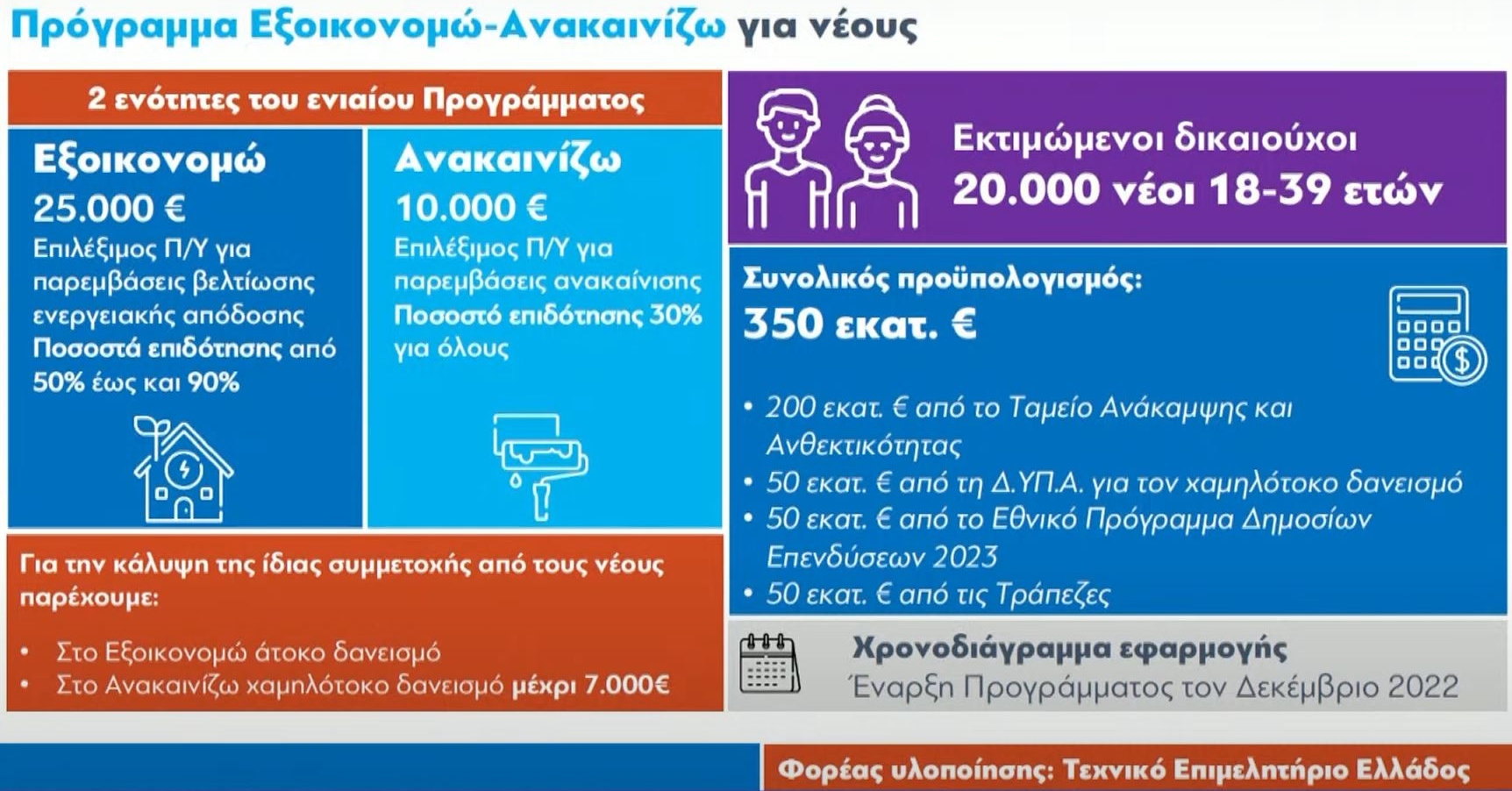
It includes interventions to improve the energy class of the house, such as the upgrade of the heating/air conditioning system, the replacement of frames, the external insulation, etc. To implement the works, young people can receive an interest-free loan. Conditions for receiving the subsidy are that the individual/family income is up to 50,000, the property is either an ancestral home that has been transferred, it is privately owned or occupied, it has full ownership or usufruct.
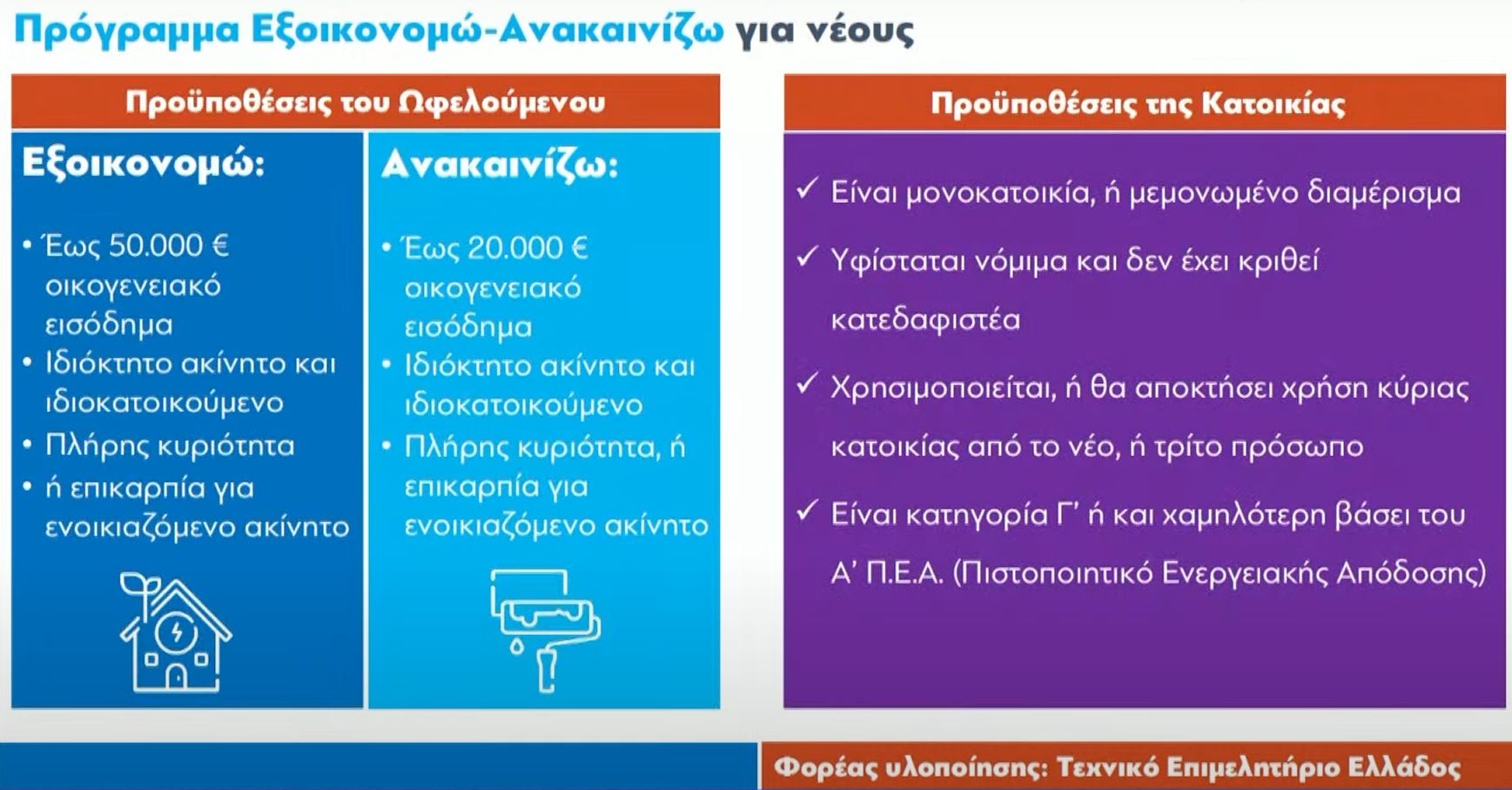
The second pillar which concerns the renovation, concerns budget interventions of up to 10,000 euros and will concern interventions for room renovations (floors, coatings, etc.) but also the purchase of household appliances such as a refrigerator or a high energy class kitchen. The subsidy in this case is horizontal at a rate of 30%. In this case, beneficiaries can get a loan of up to 7,000 which will be low interest. For renovation interventions, conditions for participation in the sub-programme are that the individual/family income is up to 20,000, the property is either an ancestral home that has been transferred, it is privately owned or occupied, it has full ownership or usufruct.
In any case, the property must exist legally, be already in use or about to be used, be a single-family house or an apartment that belongs to energy category C or lower.
The criteria for renovations of empty houses
Mr. Skrekas also referred to the separate program that concerns the renovations of vacant homes through the "My Home" program, noting that the country has a large inventory of vacant homes. As he pointed out, this is an important, new program which has a budget of 50 million euros and a subsidy of up to 40% for invoices for material works and offers the possibility to owners with a taxable income of up to 40,000 euros to renovate the houses and use them for housing young people people for at least three years. Homes up to 100 square meters are eligible and the condition is that the home has not been rented in the previous period or is declared vacant. The eligibility of the beneficiaries will be comparative, that is, those with real estate of lesser value will be selected.
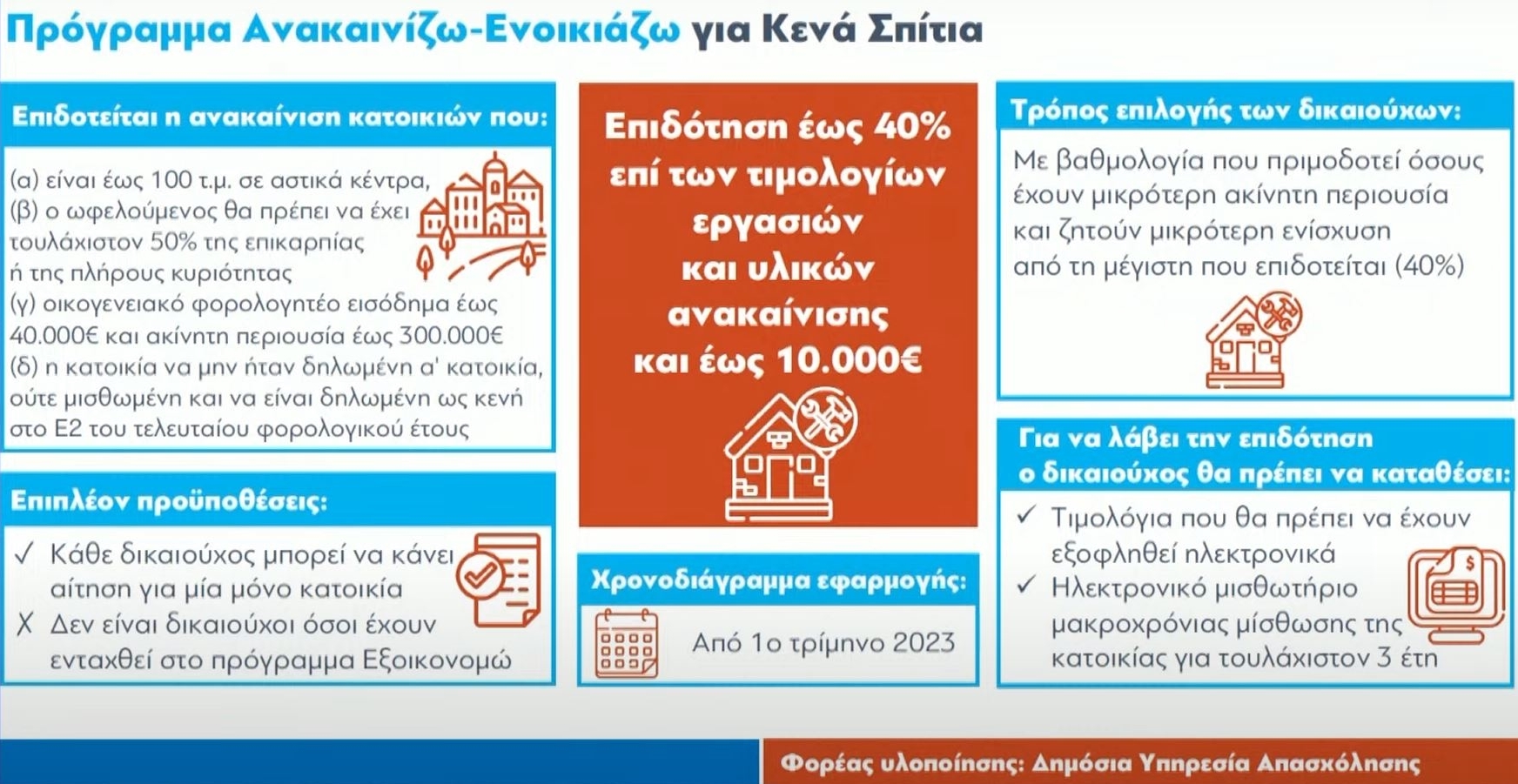
Finally, it is noted that in these programs, each beneficiary will be able to apply for a single residence, while the condition is that they have not joined another savings plan.